Last updated: July 24, 2026
How to read this page. We have not purchased this course or run its procedures on a test bench. Nothing here is a hands-on validation of every guide inside. What follows checks the public sales claims against ordinary battery chemistry and safety practice. The link on this page is an affiliate link — we may earn a commission if you buy — which is why the limits stay in the article.
EZ Battery Reconditioning is a $47 one-time digital course sold through ClickBank at ezbatteryreconditioning.com. It is one of the longer-running offers in the “green energy / DIY” ClickBank category. Creators are named as Tom Ericson and Frank Thompson. The honest core is lead-acid sulfation salvage. The sales packaging sells something much larger.
What you actually receive
No hardware ships. After checkout you get digital guides (and whatever bonuses the current funnel is bundling). Per public sales pages, that typically includes:
- Step-by-step reconditioning guides with diagrams
- Coverage spanning multiple battery types (treat non-lead-acid sections with extreme caution)
- Lifetime support / updates claimed on the sales page
- 60-day money-back guarantee via ClickBank
Expect to supply your own multimeter, and for flooded cells a hydrometer, distilled water, and basic PPE. Some methods discussed in this niche also involve chemical additives or specialized chargers — budget and risk those separately from the $47 download.
The chemistry that is real
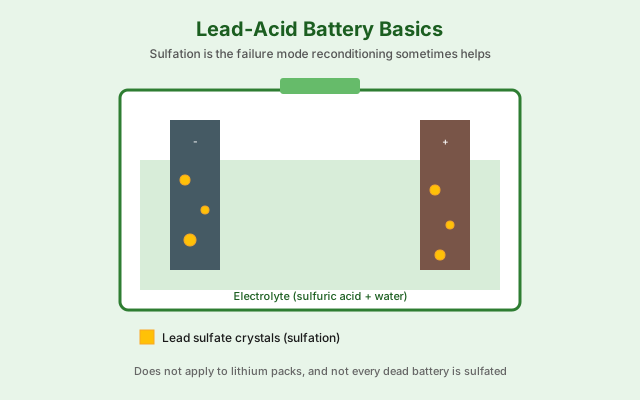
In a flooded lead-acid battery, discharge forms lead sulfate on the plates. If the battery sits discharged or is chronically undercharged, that sulfate can harden. Capacity drops, internal resistance rises, and the battery looks “dead” even though the plates are not necessarily scrap yet.
Professional and DIY desulfation / equalization approaches aim to reverse soft or moderate sulfation: controlled charging, sometimes pulse desulfators, careful electrolyte maintenance. When it works, you often getpartial capacity back and some extra months or years — salvage, not a factory-new battery. That is established electrochemistry, not free energy.
That is the only use case we treat as on-topic and defensible for a green energy / backup-storage audience: car, marine, golf-cart, and some deep-cycle banks used with solar or standby power.
Where the marketing overreaches
- “Nearly any dead battery” / “all kinds”: No. Internal shorts, shed active material, cracked cases, dry/starved damage, and many sealed failures are not sulfation problems. Diagnosis matters; many batteries are landfill or recycling, not candidates.
- “Back to 100%”: Unrealistic as a default outcome. Successful salvage is usually incomplete and temporary relative to a new cell.
- Testimonials spanning phones, laptops, AA/AAA, cameras:Those are mostly different chemistries (lithium-ion, NiMH, alkaline primaries). Treating them like flooded lead-acid is where this category goes from optimistic to wrong.
- “Slash your electric bills by up to 75%”: Category error. Reconditioning storage does not generate electricity. At best you delay buying a replacement battery for a bank you already own.
Hard safety fence
Do not treat this as a license to open, cook, or “hack” lithium-ion packs with household chemicals or improvised high-current methods. Lithium cells can vent, catch fire, or explode when abused. Sealed AGM and gel batteries also are not “pour Epsom salt in” projects. For flooded lead-acid work: eye protection, gloves, ventilation (hydrogen), no sparks near charging batteries, and neutralize acid spills properly. If a cell is swollen, leaking, or shorted, recycle it — do not experiment.
How to judge success if you try it
Before and after matters more than hope:
- Resting voltage and voltage under a known load
- For flooded cells: specific gravity per cell with a hydrometer
- Whether the battery still meets the amp-hour needs of your load
If capacity does not recover enough for the job, replacement is the honest answer. For solar and backup banks, a weak “revived” battery that dies mid outage is worse than a planned swap.
Our take
If you already own sulfated flooded lead-acid batteries and want structured DIY instructions — and you will ignore the any-battery / 100% / bill-cut framing — $47 with a 60-day refund window is a low-stakes way to evaluate the material. The underlying sulfation problem is real.
If you were sold on resurrecting laptop packs, phone batteries, or cutting your utility bill, this is the wrong product and the wrong expectation. Generation and load reduction are covered in ourDIY solar basics andenergy bill guides; backup storage choices are inbackup power options.
Affiliate link. We may earn a commission at no extra cost to you. Read the sections above before deciding.